Workshop · about
The AlelBiben workshop in Saumur
A neighbourhood forge, four pairs of hands and one simple rule: ship only what we would want to receive. Here is how we work, transparently.
7 min · Updated 5 November 2026
AlelBiben is a metalwork and furniture workshop in Saumur, Maine-et-Loire. Four people, a little grinding dust, oak offcuts sorted by length and one simple rule: ship only what we would want to receive. We make guardrails, staircases, gates, tables, stretch ceilings and hardware, in steel and solid wood.
Our story
The workshop opened in Saumur in 2026, after fifteen years in metalwork between ironwork shops and locksmithing sites. It is not a career change: it is the logical next step of a trade learned on the bench, with a file and a welding torch, then refined working for architects and character houses. Saumur imposed itself for two reasons. Material first: tuffeau, slate roofs, narrow townhouses and the Loire banks all demand bespoke work, never standard. Human second: in a region this size, a workshop that draws, welds, paints and installs itself stays useful, because the pieces requested do not exist in any catalogue.
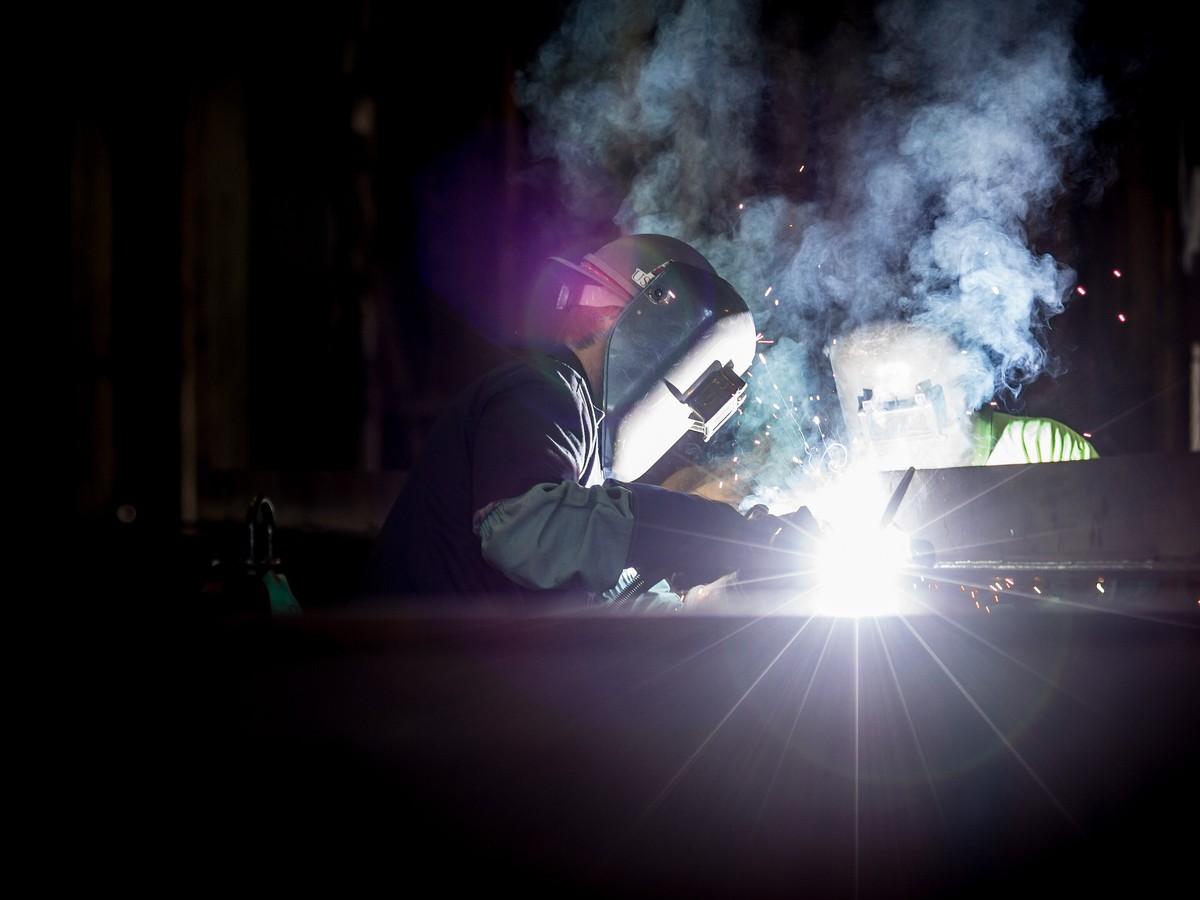
The workshop occupies an old craftsman’s unit, with a door wide enough for a four-metre stringer — the first thing we checked when visiting. No access, no staircase. Stone walls, concrete floor, and lighting strong enough to inspect a weld under grazing light.
Our values
Five principles hold the workshop together, and they show in the quote as much as in the finished piece: draw to the dimension, not to a catalogue; one single point of contact; repair before replacing; give a price range before travelling; and write lead times down so they bind us.
The process, step by step
Every piece passes through five stations, each with its own tolerances — the combination is what makes a precise part.
01
Cutting
Band saw, disc and punch. Cuts are laid out from the drawing, not chalked on the floor.
02
Welding
Stick for heavy sections, MIG for everyday steel, TIG for stainless and visible corners.
03
Grinding
The station that decides whether a weld shows. Angle grinder, flap discs, hand finishing.
04
Protection and paint
Degreasing, primer, outsourced hot-dip galvanising, two-coat powder coating and curing.
05
Wood
Jointing, planing, assembly, sanding and hard wax oil. Timber is stored and machined on site.
The team
We are four, with deliberately overlapping roles: at this size, nobody does only one thing. The workshop lead draws, calculates and talks to architects — and says “no, that will not hold” before fabrication. The welder cuts, welds, grinds and assembles. The cabinetmaker joints, planes, assembles and finishes the timber. And the coordinator runs appointments, quotes, orders, installation schedules and client contact.
Our commitments
A dimensioned plan approved by you before fabrication; a firm price after plan approval; written lead times counted from plan approval; a free follow-up visit one month after installation; sorted waste; no manufacturing subcontracted abroad; and pieces designed to be repaired, with accessible fixings and replaceable parts.
The workshop in figures
Four figures describe the structure: small enough to draw every piece, equipped enough to build it entirely.
4
People in the workshop
11
Catalogue families
200 km
Service radius
2026
Opened in Saumur
To prepare a visit, start with what we make in Saumur and the projects from the workshop . If you already have dimensions, the configurator gives a price in minutes.
Come and see the workshop
A coffee, the materials at hand, an offcut of oak and a piece of steel: the best way to understand what your budget allows.